
Achieving Long-Term Financial Goals: Planning for the Future
Picture this: you’re sitting on your porch at 65, sipping coffee without a care in the world because you’ve built the financial foundation that supports your dreams. Whether it’s buying your first home, sending your kids to college, or retiring comfortably, achieving long-term financial goals doesn’t happen by accident. It requires intentional planning, consistent action, and the wisdom to start today rather than tomorrow.
The journey to financial security might seem overwhelming, especially when you’re juggling immediate expenses and trying to make ends meet. But here’s the truth that many successful savers have discovered: the earlier you start planning for your future, the less stressful and more achievable your financial goals become. Let’s explore how you can create a roadmap that turns your financial dreams into reality.
Understanding Your Financial Destination
Before you can plan your route, you need to know where you’re going. Long-term financial goals typically span five years or more and often include major life milestones. These might include purchasing a home, funding your children’s education, starting a business, or building a retirement nest egg that allows you to maintain your desired lifestyle.
The key to successful financial planning lies in making your goals specific and measurable. Instead of saying “I want to retire comfortably,” try “I want to have $1.2 million saved by age 65 to generate $48,000 in annual retirement income.” This specificity helps you calculate exactly how much you need to save each month and gives you a clear target to work toward.

Consider also the timeline for each goal. A house down payment might be needed in seven years, while retirement could be thirty years away. Different timeframes require different strategies, and understanding this will help you prioritize your savings and investment approaches accordingly.
Creating Your Personal Financial Blueprint
Think of your financial plan as the blueprint for your future. Just as you wouldn’t build a house without architectural plans, you shouldn’t pursue financial goals without a structured approach. Start by conducting an honest assessment of your current financial situation. This includes calculating your net worth, understanding your monthly cash flow, and identifying your risk tolerance.
Your financial blueprint should account for inflation, which quietly erodes purchasing power over time. What costs $100 today will likely cost $134 in ten years, assuming a 3% annual inflation rate. This means your long-term goals need to account for this reality, requiring you to save more than you might initially think.
Emergency funds form the foundation of any solid financial plan. Before aggressively pursuing long-term goals, ensure you have three to six months of expenses saved in an easily accessible account. This safety net prevents you from derailing your long-term plans when unexpected expenses arise, such as job loss or major medical bills.
The Power of Compound Interest in Long-Term Planning
Albert Einstein allegedly called compound interest the eighth wonder of the world, and for good reason. When you invest money, you earn returns not just on your initial investment, but also on the returns themselves. Over long periods, this compounding effect becomes incredibly powerful and is your greatest ally in achieving substantial financial goals.
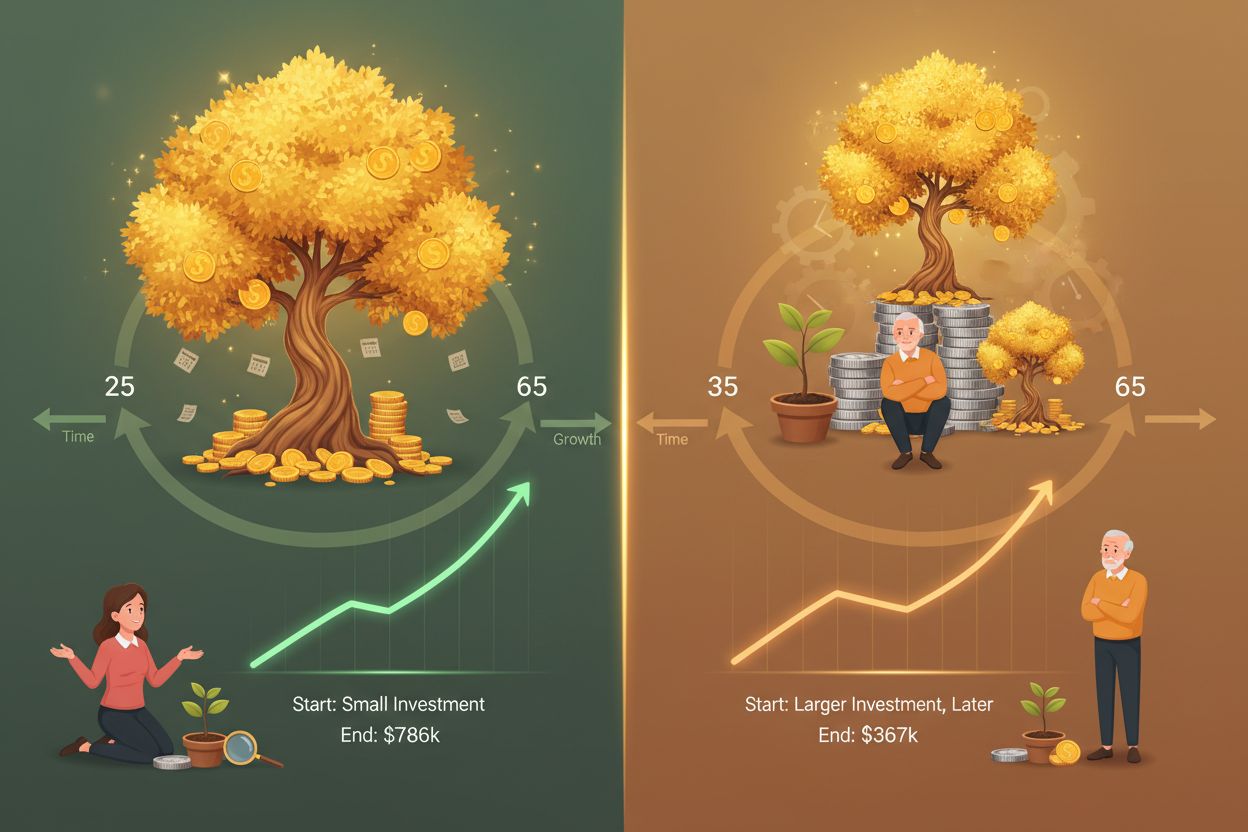
Consider Sarah, who starts investing $300 monthly at age 25, earning an average 7% annual return. By age 65, she’ll have contributed $144,000 but accumulated over $786,000. Compare this to her friend Mike, who waits until 35 to start the same investment plan. Despite contributing for ten fewer years, Mike ends up with only about $367,000. This dramatic difference illustrates why starting early, even with smaller amounts, often trumps waiting to invest larger sums later.
The lesson here isn’t to discourage late starters, but to emphasize that time is your most valuable asset in financial planning. If you’re starting later, you’ll need to save more aggressively or consider investments with potentially higher returns, which typically come with increased risk.
Strategic Investment Approaches for Different Time Horizons
Your investment strategy should align with your timeline and risk tolerance. For goals more than ten years away, you can typically afford to take more risk in exchange for potentially higher returns. This might mean investing heavily in stock market index funds or growth-oriented mutual funds that historically outperform bonds and savings accounts over long periods.
For medium-term goals (five to ten years), consider a balanced approach mixing stocks and bonds. This provides growth potential while offering some protection against market volatility. As you get closer to needing the money, gradually shift toward more conservative investments to preserve your gains.
Short-term goals (less than five years) generally call for conservative approaches. High-yield savings accounts, certificates of deposit, or short-term bond funds help preserve your capital while providing modest growth. The key is avoiding the risk of significant losses when you’ll need the money soon.
Diversification across different asset classes, geographic regions, and investment vehicles helps manage risk while maintaining growth potential. Don’t put all your eggs in one basket, whether that’s a single stock, one type of investment, or even one investment account.
Maximizing Tax-Advantaged Accounts
The government provides several tools to help you save for long-term goals while reducing your tax burden. Understanding and maximizing these accounts can significantly accelerate your progress toward financial independence.
For retirement planning, 401(k) plans offer immediate tax deductions and potential employer matching. If your employer matches contributions, prioritize getting the full match before investing elsewhere – it’s essentially free money. Individual Retirement Accounts (IRAs) provide additional tax-advantaged space, with traditional IRAs offering current tax deductions and Roth IRAs providing tax-free withdrawals in retirement.
For education funding, 529 plans allow tax-free growth and withdrawals for qualified educational expenses. These plans often offer state tax deductions and can be used for K-12 tuition as well as college expenses. Health Savings Accounts (HSAs) serve triple duty: tax-deductible contributions, tax-free growth, and tax-free withdrawals for medical expenses. After age 65, you can withdraw funds for any purpose, making HSAs excellent retirement planning tools.
Staying on Track: Monitoring and Adjusting Your Plan
Life rarely goes according to plan, and your financial strategy should be flexible enough to adapt to changing circumstances. Regular reviews – at least annually – help ensure you’re making progress toward your goals and allow you to make necessary adjustments.
Market performance, salary changes, family additions, or shifts in priorities might require plan modifications. Perhaps you receive a promotion and can increase your savings rate, or maybe you decide to pursue a different career path that affects your timeline. The key is staying engaged with your plan rather than setting it and forgetting it.
Automate as much as possible to remove emotion and forgetfulness from the equation. Set up automatic transfers to savings and investment accounts, and increase these amounts annually or whenever you receive raises. This “pay yourself first” approach ensures your future self is prioritized before discretionary spending takes over.
Track your progress using financial apps, spreadsheets, or regular statements. Celebrate milestones along the way – reaching your first $10,000 saved or hitting 25% of your goal deserves recognition. These celebrations help maintain motivation during the long journey toward financial independence.
Overcoming Common Planning Obstacles
Even with the best intentions, various obstacles can derail long-term financial planning. Lifestyle inflation – increasing spending as income rises – is one of the most common challenges. Combat this by automatically increasing your savings rate whenever you receive raises, bonuses, or other income increases.
Market volatility can trigger emotional responses that lead to poor financial decisions. During market downturns, resist the urge to sell investments at a loss or stop contributing to your accounts. History shows that markets recover over time, and consistent investing through both good and bad periods typically produces better results than trying to time the market.
Competing financial priorities can make it difficult to focus on long-term goals. You might face pressure to help family members financially, fund current lifestyle desires, or address immediate needs. While these situations require careful consideration, remember that consistently funding your long-term goals ensures you won’t become a financial burden on others later.
Building Your Financial Legacy
Achieving long-term financial goals isn’t just about accumulating money – it’s about creating options and security for yourself and your loved ones. Financial independence provides the freedom to make career choices based on passion rather than necessity, the ability to help family members during tough times, and the peace of mind that comes from knowing you’re prepared for life’s uncertainties.
Start today, regardless of your current financial situation. Even if you can only save $25 monthly, that’s $300 annually that can begin growing through compound interest. As your income increases and you develop better financial habits, you can gradually increase your savings rate and accelerate your progress.
Remember that financial planning is a marathon, not a sprint. There will be setbacks, market downturns, and unexpected expenses along the way. What matters most is maintaining consistency, staying focused on your long-term objectives, and making adjustments when necessary while keeping your eyes on the ultimate prize: financial security and the freedom it provides.
Your future self will thank you for every dollar saved and every smart financial decision made today. The path to achieving long-term financial goals begins with a single step, and there’s no better time to take that step than right now.